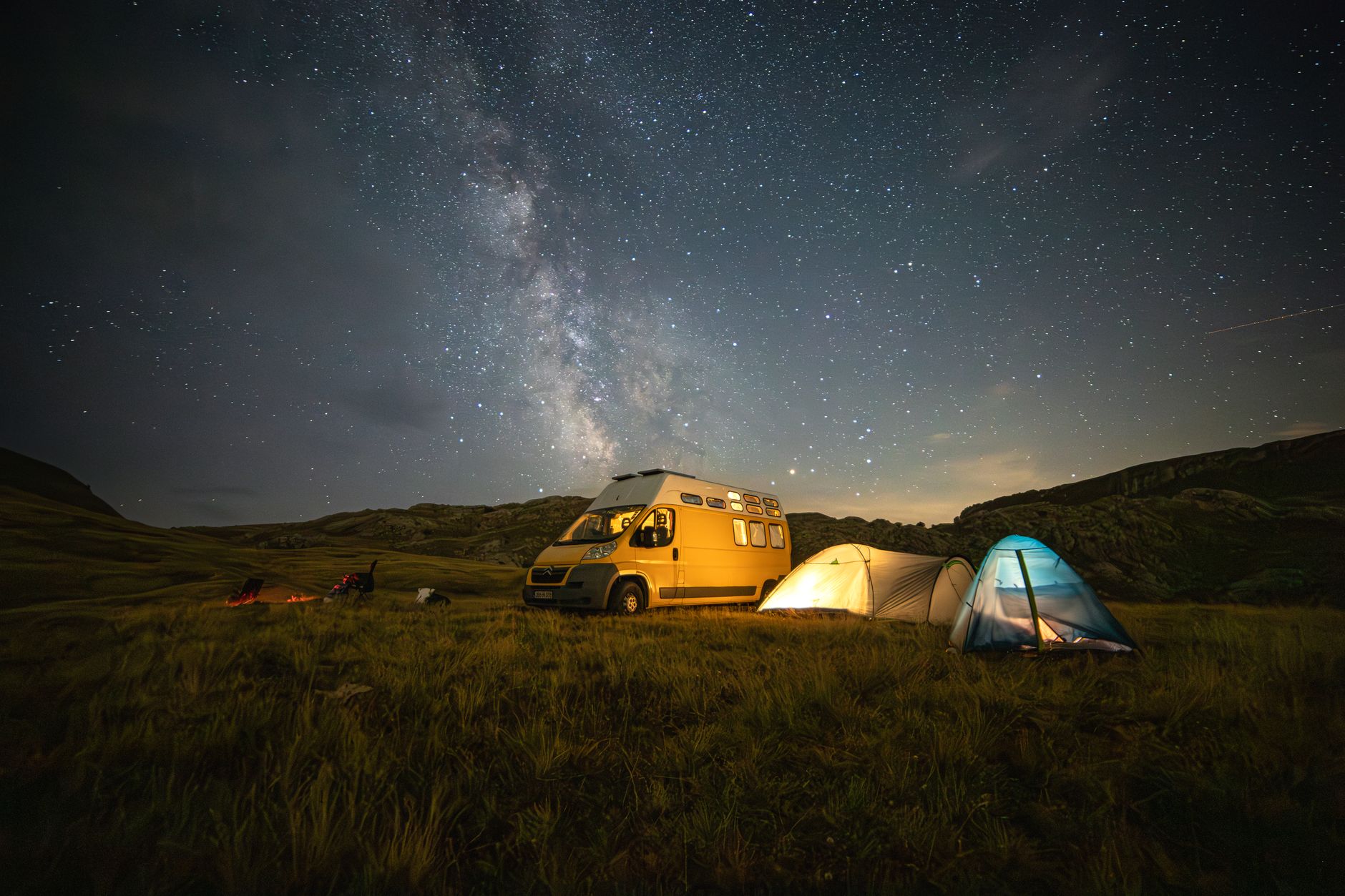
There is something properly magical about lying on your back in a field, far away from the orange glow of a town, and watching the Milky Way slowly stretch across the sky above you. I did exactly that on a warm July evening in the Brecon Beacons a couple of years back, and I have been mildly obsessed with dark sky camping ever since. If you have never tried it, this summer is the perfect time to start. The dark sky campsites UK summer scene has genuinely blossomed, and there are now dozens of brilliant spots across England, Scotland, Wales, and Northern Ireland where you can pitch a tent just minutes from some of the darkest skies on the continent.
What are Dark Sky Discovery Sites and why do they matter?
The UK has a network of officially designated dark sky places, ranging from the enormous International Dark Sky Reserves (like the Brecon Beacons and Exmoor) down to smaller local Dark Sky Discovery Sites scattered along rural footpaths and coastal headlands. The Dark Sky Discovery programme, supported by the Science and Technology Facilities Council, has mapped hundreds of these locations across the country, grading them by the quality of darkness they offer. Camping at or near one of these sites means you genuinely stand a chance of seeing thousands of stars with the naked eye, which simply is not possible anywhere near a city.
The best-known reserves include the Galloway Forest Park in Dumfries and Galloway (the first Dark Sky Park in the UK), Exmoor National Park in Somerset and Devon, the Brecon Beacons in Wales, and the Cranborne Chase Area of Outstanding Natural Beauty straddling Wiltshire and Dorset. Each has camping options nearby, many of them small and wonderfully low-key.
The best dark sky campsites to book this summer
In the Galloway Forest Park, Glentrool Camping and Caravanning Club site puts you right on the doorstep of truly spectacular darkness. On a clear night in summer, the Milky Way is visible without any optical aids at all, and I have heard from fellow campers that even satellites and the International Space Station are easy to spot from there. The forest is enormous and the light pollution practically non-existent.
Down in Exmoor, Burrowhayes Farm Campsite near Porlock is a firm favourite. It sits in a valley between high moorland ridges, which naturally blocks much of the distant glow from Taunton and Minehead. The surrounding moorland is dotted with official Dark Sky Discovery Sites, so you only need to walk five or ten minutes from your tent to find a spot with a genuinely breathtaking view of the night sky.
In Wales, the Brecon Beacons (now rebranded as Bannau Brycheiniog) earned International Dark Sky Reserve status back in 2012 and it remains one of the finest places in the whole of Europe to stargaze. Pencelli Castle Caravan and Camping Park is popular, comfortable, and close to some of the reserve’s best viewing areas. If you fancy something a bit more adventurous, cliff-top and coastal spots along the Pembrokeshire coast, which sits next to one of Wales’s darkest sky zones, are also excellent for late-night constellation hunting.
Up in Northumberland, the Kielder Water and Forest Park holds International Dark Sky Park status and is consistently ranked as one of England’s darkest places. Kielder Campsite, run by the Forestry England team, sits right inside the park. Summer nights here are short but the darkness, when it arrives after 10 pm or so, is extraordinary. I would strongly suggest booking well ahead, as it fills up fast from June through August.
For something a little different, the Isle of Sark in the Channel Islands holds Dark Sky Community status and offers a genuinely otherworldly experience. There are no street lights on the island at all, and the sky on a cloudless night looks like something from a nature documentary. The Sark Campsite is basic but perfectly positioned for a proper summer stargazing trip.
Which constellations can you spot in summer?
Summer is brilliant for stargazing in the UK, partly because the nights are warmer and you are not shivering in your sleeping bag by 9 pm. The Summer Triangle, made up of three bright stars (Vega, Deneb, and Altair) from three different constellations, is the most obvious landmark in the summer sky and almost impossible to miss once you know where to look. Scorpius sits low on the southern horizon in July and August, and Hercules is overhead.
The Perseids meteor shower peaks every year around 11-13 August, and from a dark sky campsite you can realistically expect to see 80-100 meteors per hour at peak time. I have watched the Perseids from a hillside in the Brecon Beacons and it is genuinely one of the most joyful things I have ever done outdoors. Pack something warm regardless of the forecast; lying still in a field after midnight gets chilly even in summer.
How to photograph the night sky as a complete beginner
You do not need thousands of pounds of kit to take satisfying night sky photos. A basic DSLR or mirrorless camera with a wide-angle lens and a tripod is enough to capture the Milky Way. The key settings to start with: ISO between 1600 and 3200, aperture as wide as your lens allows (f/2.8 or wider is ideal), and a shutter speed of around 20-25 seconds. Any longer and the stars start to trail as the Earth rotates.
Use a remote shutter release or your camera’s self-timer to avoid wobble when pressing the button. Point at the darkest part of the sky you can find, focus on a bright star manually (autofocus will not work in the dark), and take a test shot. Adjust your ISO up or down depending on whether the image looks too dark or too noisy. It takes a few attempts, but when it clicks, the results are genuinely stunning.
Your mobile can also produce surprisingly good results these days. Modern smartphones with night mode or a dedicated astrophotography mode, like the Google Pixel 9 or Samsung Galaxy S25, can capture reasonable Milky Way shots with zero extra kit. Use a small portable tripod and experiment with your phone’s pro or manual mode if it has one.
Making the most of your dark sky camping trip
A few practical things worth knowing before you go. Let your eyes adapt; it takes roughly 20-30 minutes for your night vision to fully develop, so resist the urge to check your phone. Use a red torch rather than a white one if you need to see your way around camp, as it preserves your night vision. Check the lunar calendar before booking; a full moon washes out faint stars, so aim for a new moon or the days immediately around it.
And do not forget the daytime. Many of these sites are brilliant for wildflower walks and nature exploring during the day, and some of the best dark sky camping spots, particularly those in the Galloway Forest or Exmoor, are surrounded by gorgeous summer landscapes that deserve exploring before the stars come out. A packed lunch from a local farm shop makes the whole thing feel properly celebratory. Speaking of which, if you are planning the food side of a camping trip carefully, our guide to the best artisan picnic food in the UK has plenty of ideas for eating brilliantly outdoors.
Dark sky camping is one of those experiences that sounds simple but stays with you. Pack a flask of something hot, lie flat on your back, and just look up. The universe is enormous and, from the right campsite, it is absolutely right there above your head.
Frequently Asked Questions
What are the best dark sky campsites in the UK for summer?
Kielder Campsite in Northumberland, Glentrool in the Galloway Forest Park, and Burrowhayes Farm on Exmoor are among the top picks. All sit within or close to officially designated dark sky reserves, giving you excellent visibility on clear summer nights.
When is the best time of year to go dark sky camping in the UK?
Late July through September is ideal. The Perseids meteor shower peaks around 11-13 August, temperatures are more comfortable overnight, and the skies are often clearer than in winter. The only trade-off is shorter periods of darkness compared to winter months.
Do I need special equipment for stargazing at a dark sky campsite?
Not at all. A blanket or reclining chair, a red torch to preserve your night vision, and clear skies are enough to enjoy hundreds of stars with the naked eye. Binoculars add a lot for very little cost if you want to look at the Moon or star clusters more closely.
How do I photograph the Milky Way as a beginner?
Use a camera on a tripod with a wide-angle lens set to f/2.8 or wider, ISO 1600-3200, and a shutter speed of around 20 seconds. Focus manually on a bright star before composing your shot. Modern smartphones with night modes can also produce good results if you use a small tripod.